

Campbell’s Dwarf Hamsters
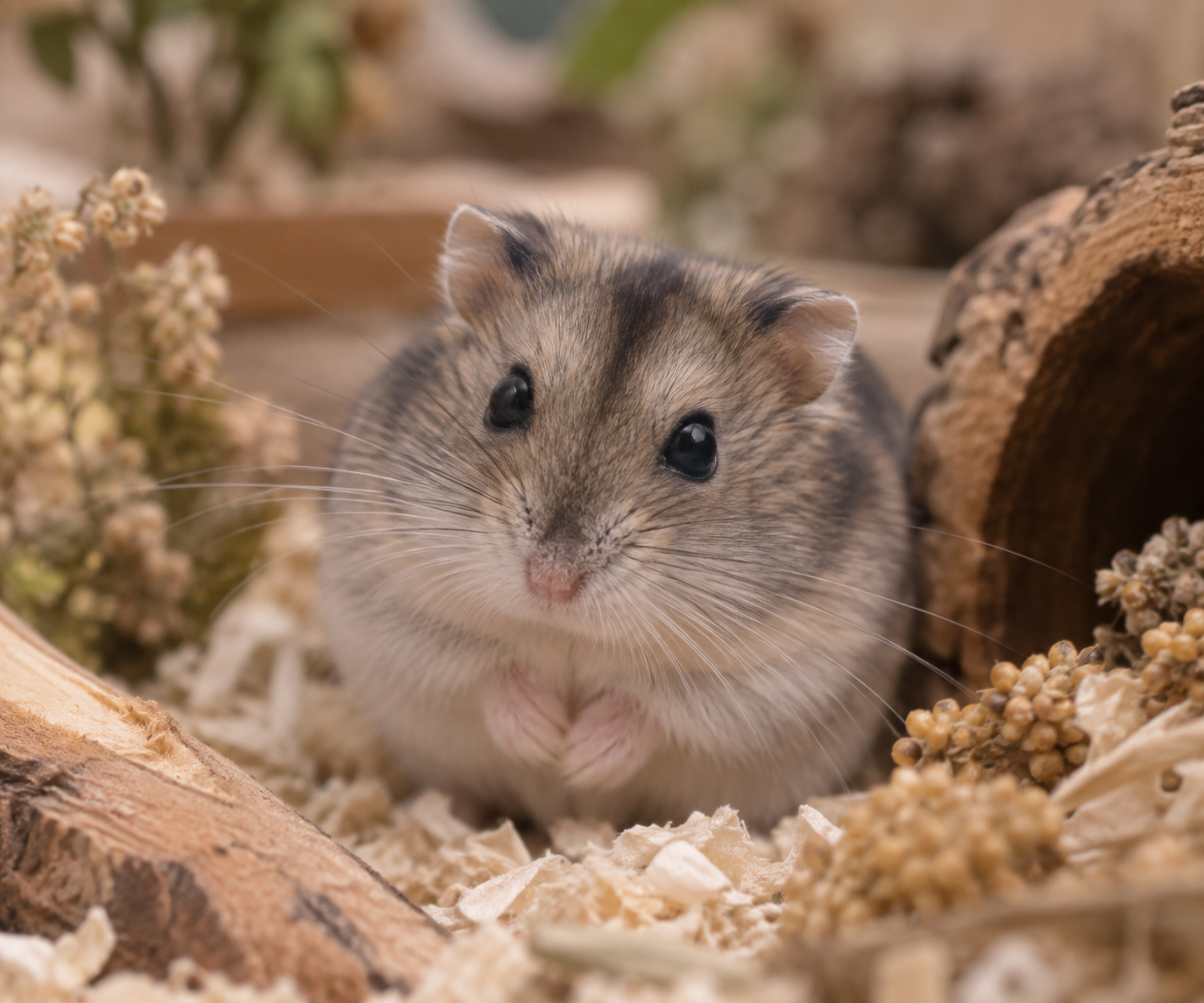
Scientific name: Phodopus campbelli
Common name: Campbell’s dwarf hamster / Campbell’s Russian dwarf hamster
Adult length: approximately 8–10 cm
Diet: omnivorous
Activity: primarily evening and nighttime
Housing: individual housing recommended
Lifespan: commonly around 1.5–3 years, although individuals vary
Setting Up An Enclosure
·
Setting Up An Enclosure ·
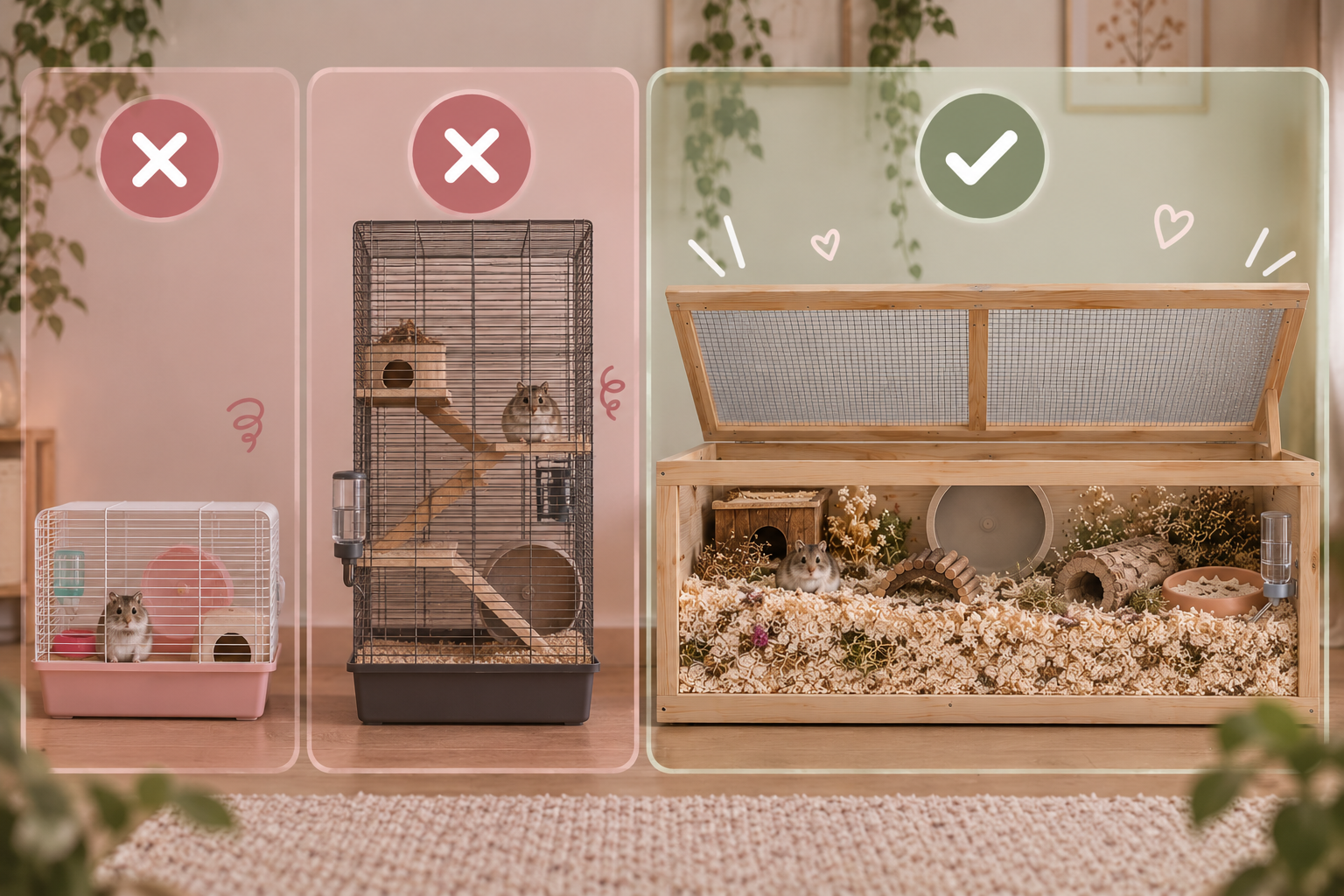
Little Moon recommends an enclosure measuring at least:
100 cm L × 50 cm W
This provides approximately 5,000 cm² of continuous floor space.
Larger enclosures are always welcome when space and circumstances allow.
A spacious enclosure allows your hamster to create distinct areas for sleeping, burrowing, running, foraging, grooming and toileting. It also provides enough room for essential equipment without leaving the habitat overcrowded.
♡ Prioritising Floor Space
Hamsters are primarily terrestrial and burrowing animals. Levels can provide some additional interest, but they should never be used to compensate for insufficient continuous floor space.
Prioritise:
♡ length
♡ width
♡ deep substrate
♡ uninterrupted usable floor area
Suitable housing can include:
♡ large glass tanks
♡ appropriately ventilated acrylic enclosures
♡ large barred enclosures with deep bases
♡ properly converted storage-bin enclosures
♡ purpose-built hamster habitats
Whatever style you choose, it should be secure, well ventilated, escape-resistant and capable of holding deep bedding.
♡ Choosing the Right Location
The location of your hamster's enclosure is an important part of their care.
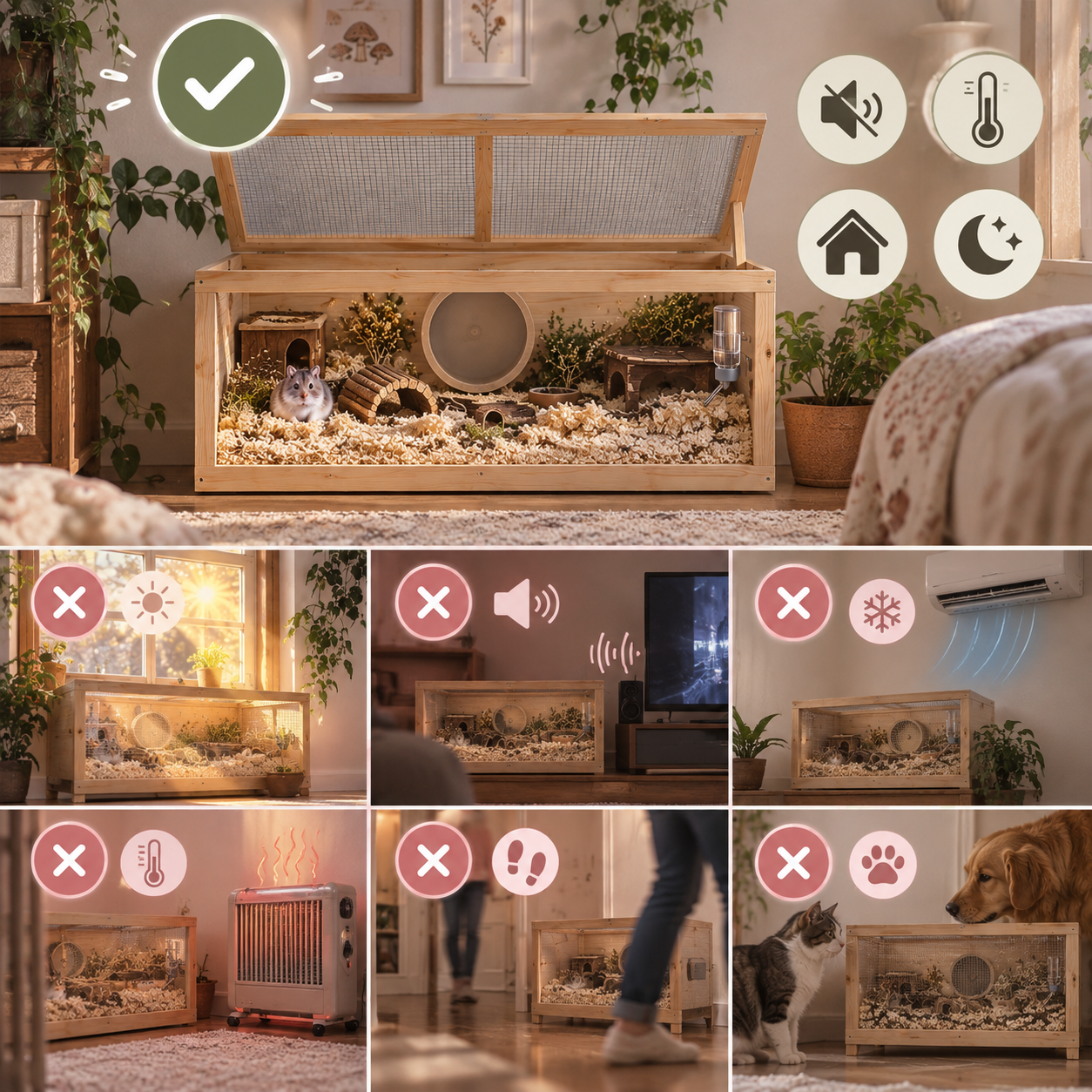
Choose a quiet indoor area with a relatively stable temperature and predictable day/night cycle.
Keep the enclosure away from:
✕ direct sunlight
✕ heaters
✕ cold draughts
✕ air-conditioning vents
✕ loud televisions or speakers
✕ areas of constant disturbance
Hamsters have sensitive hearing and a highly developed sense of smell, so a calm environment can help them feel secure.
☀️ Warm-climate care
In warm climates, extra care should be taken to prevent overheating.
Glass and acrylic enclosures can become hot surprisingly quickly when exposed to sunlight. Always position the enclosure away from direct sun and monitor the room temperature during warmer weather.
Bedding and Burrowing
·
Bedding and Burrowing ·
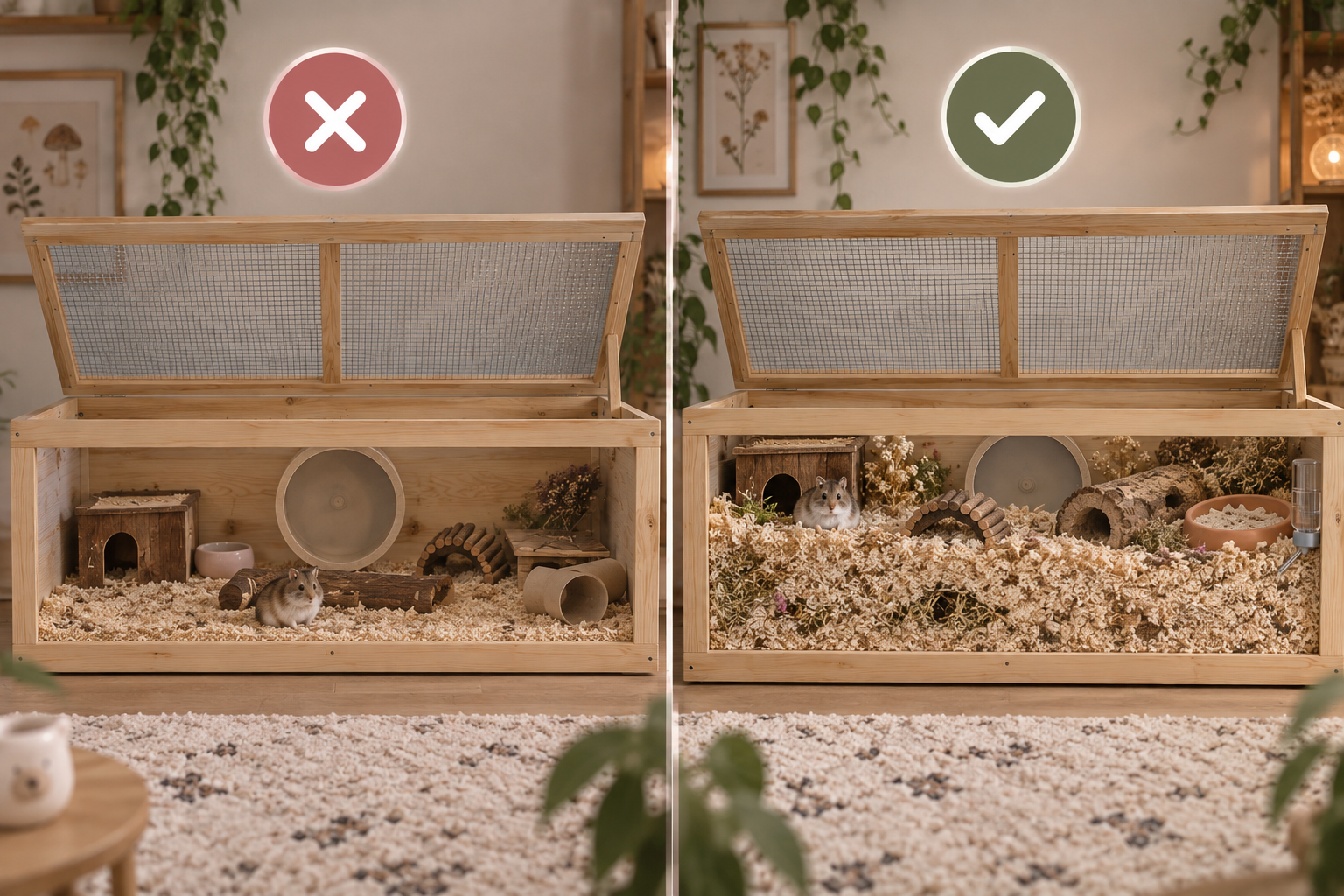
♡ Little Moon recommends:
20 cm of bedding deeper wherever possible
Burrowing is one of the most important behaviours we can accommodate in captivity.
Deep bedding allows your hamster to construct tunnels, sleeping chambers and food-storage areas. It also greatly increases the amount of usable space available within the habitat.
Suitable bedding may include:
♡ high-quality unscented paper bedding
♡ low-dust paper-based bedding
♡ suitable hemp bedding
♡ appropriate dust-extracted aspen
The bedding should be:
low dust + absorbent + non-toxic + capable of supporting tunnels.
♡ Creating stable burrows
When filling the enclosure, gently compress the bedding in layers.
Extremely loose bedding may collapse when your hamster attempts to tunnel through it. Lightly compacted bedding provides more structure while remaining easy to excavate.
Suitable soft hay may also be layered through compatible bedding to provide additional structural support.
Your hamster can then create and modify their own burrow system. ♡
♡ Safe Nesting Material
Nesting material allows your hamster to create a warm, comfortable sleeping area.
Provide:
♡ plain unscented toilet tissue
♡ shredded unscented paper
♡ other verified safe paper nesting materials
Place the material within the enclosure and allow your hamster to collect and arrange it themselves.
✕ Avoid
✕ cotton wool
✕ fluffy hamster bedding
✕ synthetic nesting fibres
✕ fabric threads
✕ heavily scented materials
Some fluffy materials can become tangled around limbs or cause problems when swallowed or placed into the cheek pouches.
Simple paper-based nesting material is generally a much safer choice.
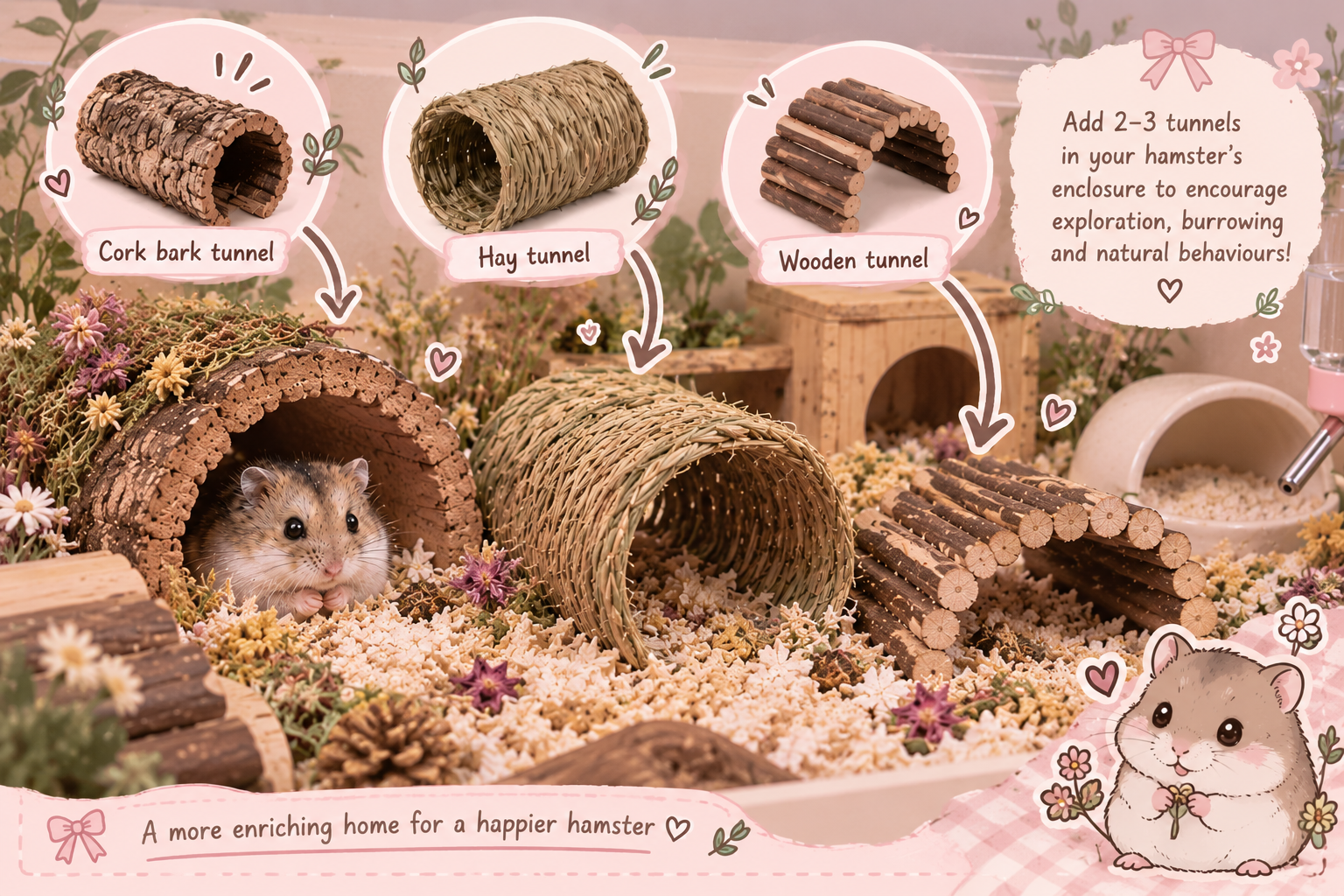
Little Moon recommends the addition of 2-3 tunnels in your hamster’s enclosure!
Hides
·
Chambers
.
Platforms
.
Hides · Chambers . Platforms .
For a Campbell’s dwarf hamster enclosure, we recommend providing at minimum:
♡ 1 multi-chamber hide
♡ 2 wooden hides
♡ 1 ceramic hide
Additional cork tunnels, underground hides, cardboard shelters and other safe hiding spaces are warmly encouraged.
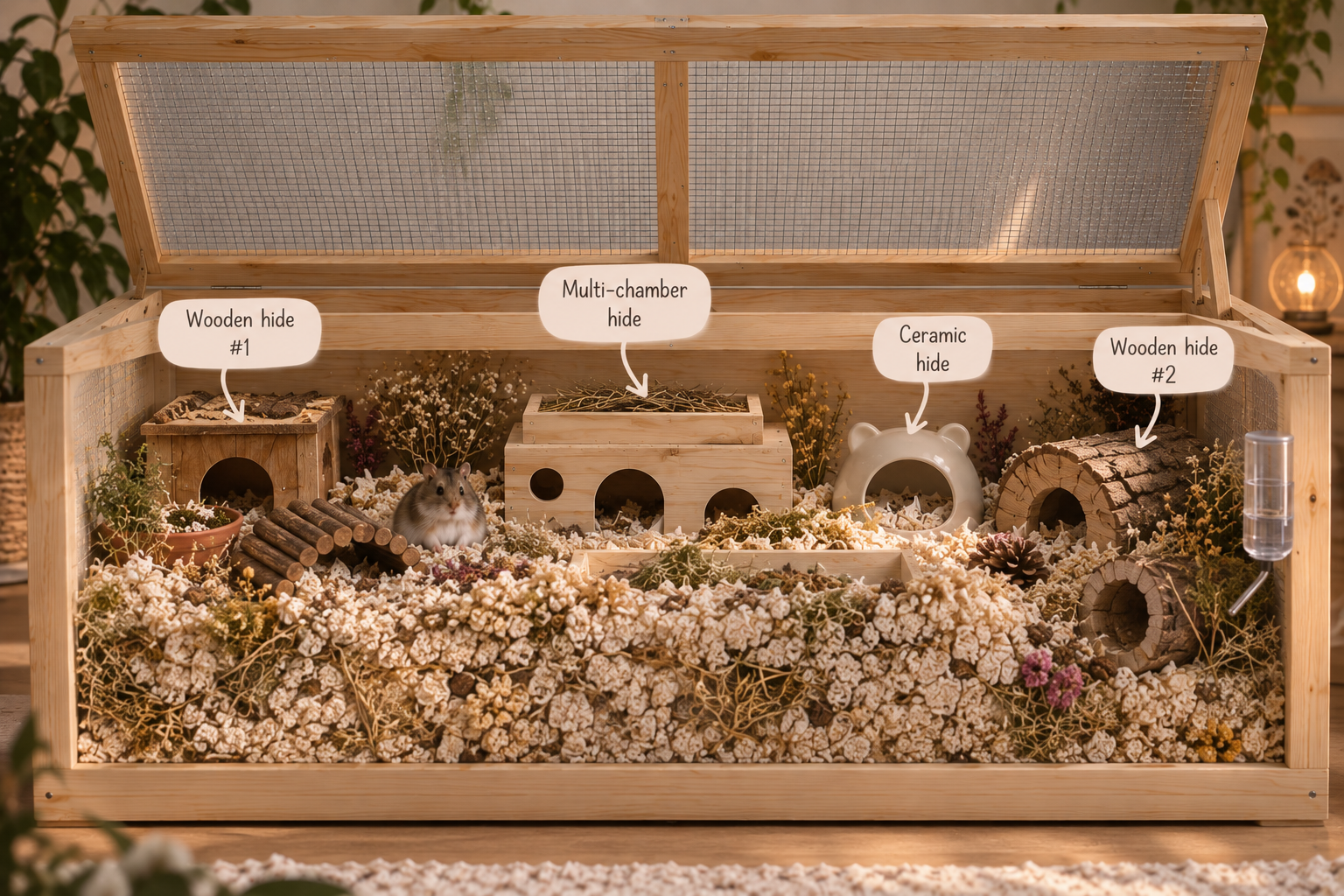
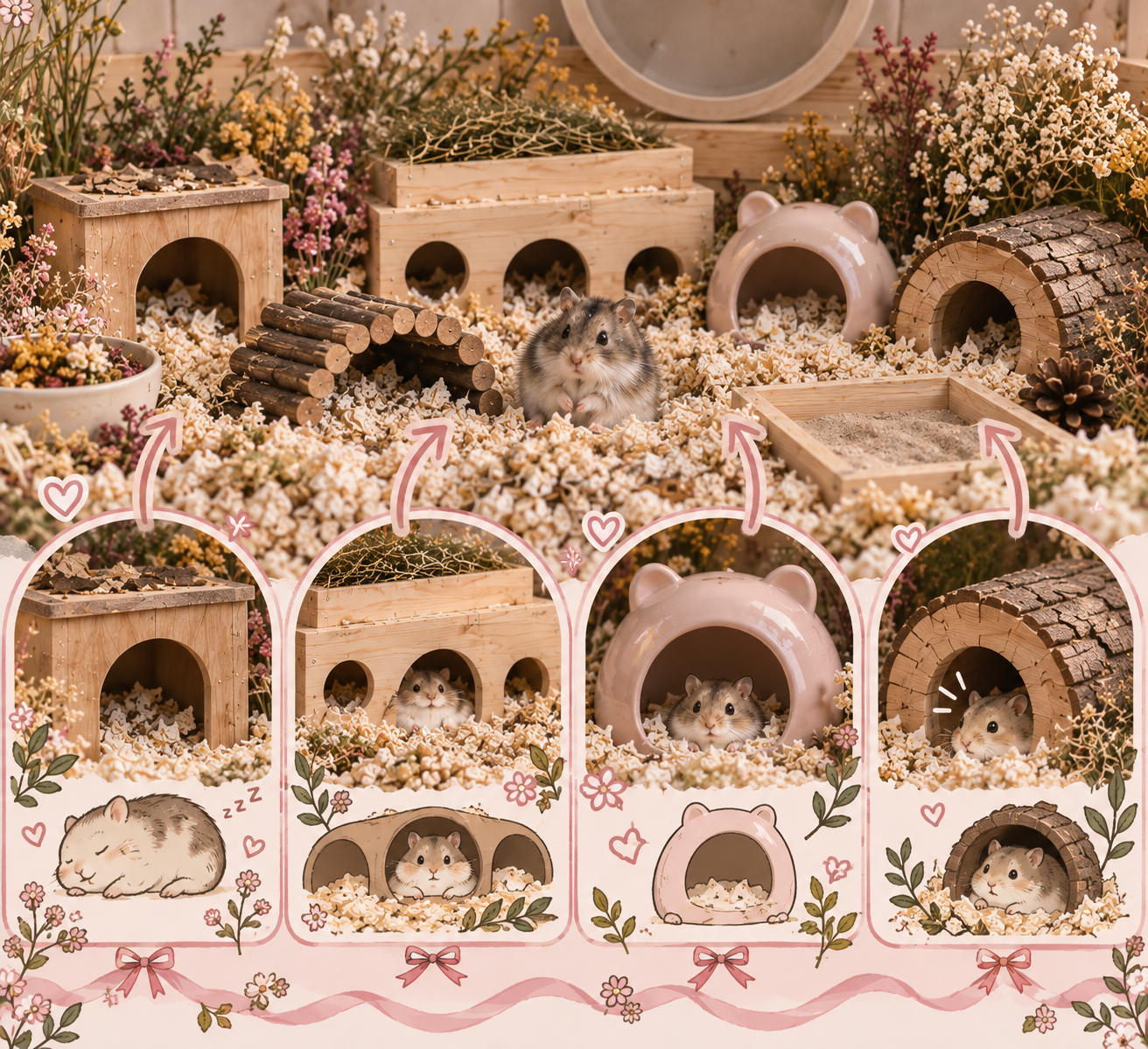
🎀 Why Offer Different Types of Hides?
Not every hamster will use every hide in the same way.
One hamster might sleep almost exclusively inside its multi-chamber hide while another creates an underground nest beneath a wooden shelter. A ceramic hide might become a favourite resting spot, while another hamster may barely use it.
That's okay.
The purpose of providing several suitable options isn't to make your hamster use every accessory.
The purpose is to let them choose. ♡
Choice and control over their environment are important components of good animal welfare.
🪵 Platforms
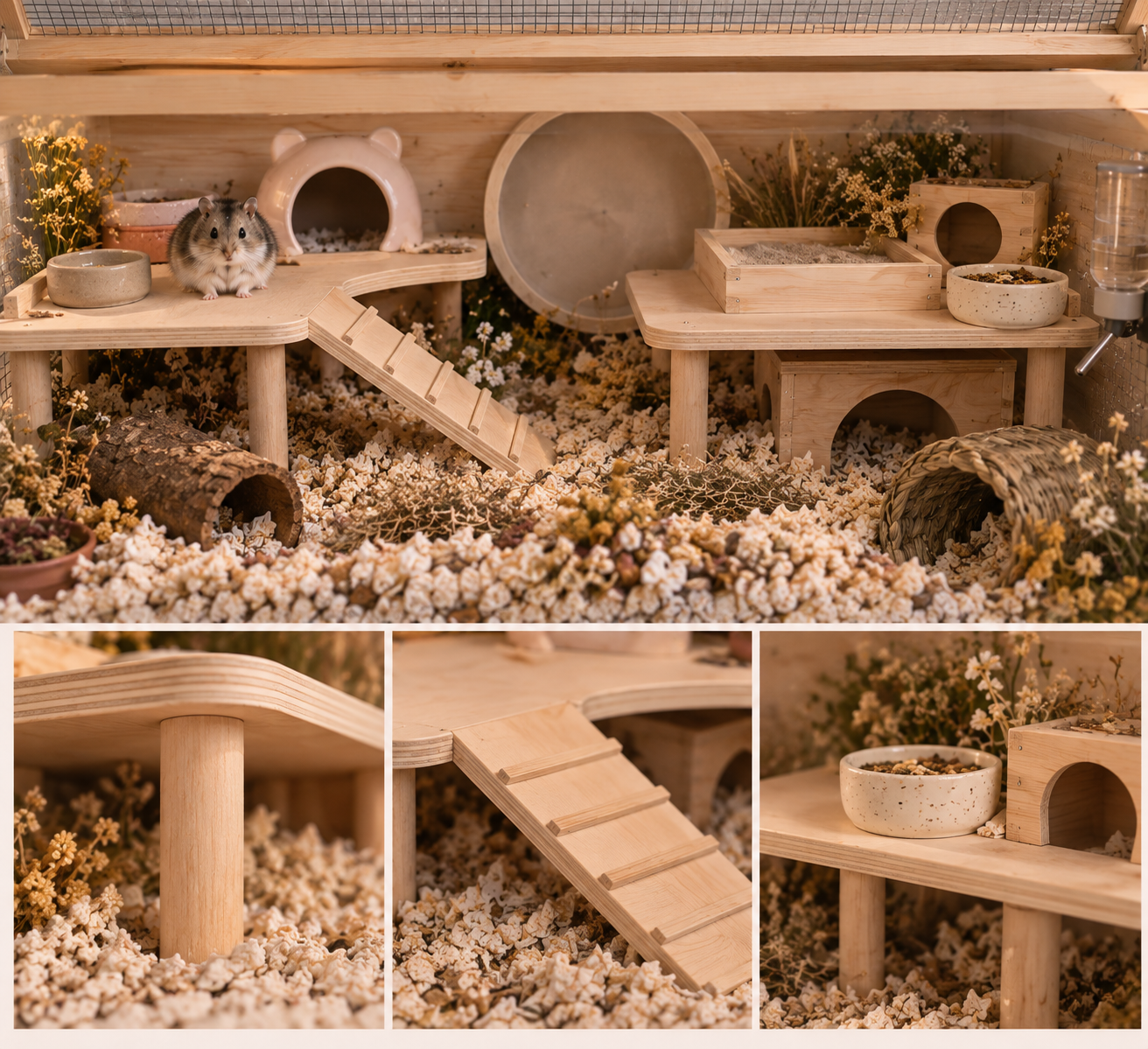
Platforms become especially important when providing the 20–25+ cm of bedding recommended elsewhere in this guide.
Hamsters are enthusiastic burrowers and may tunnel directly underneath enclosure furniture. A heavy ceramic hide, wheel or sand bath placed directly on loose bedding could become unstable as the hamster excavates underneath it.
Platforms provide a stable foundation that transfers the weight of heavy accessories safely toward the enclosure floor.
Place platforms beneath heavy items such as:
♡ ceramic hides
♡ running wheels
♡ large sand baths
♡ water bowls
♡ heavy multi-chamber hides where appropriate
♡ other substantial enclosure furniture
The supporting legs should extend securely down to the enclosure floor.
Bedding can then surround the platform, allowing your hamster to continue burrowing nearby.
⚠️ Heavy Items & Deep Bedding
As a simple rule:
Heavy object + deep bedding = secure support underneath.
Avoid balancing heavy objects directly on top of loose substrate.
Check platforms periodically to make sure they remain stable and have not been damaged through chewing.
Wheels
·
Water
.
Nutrition
.
Wheels · Water . Nutrition .
Wheel
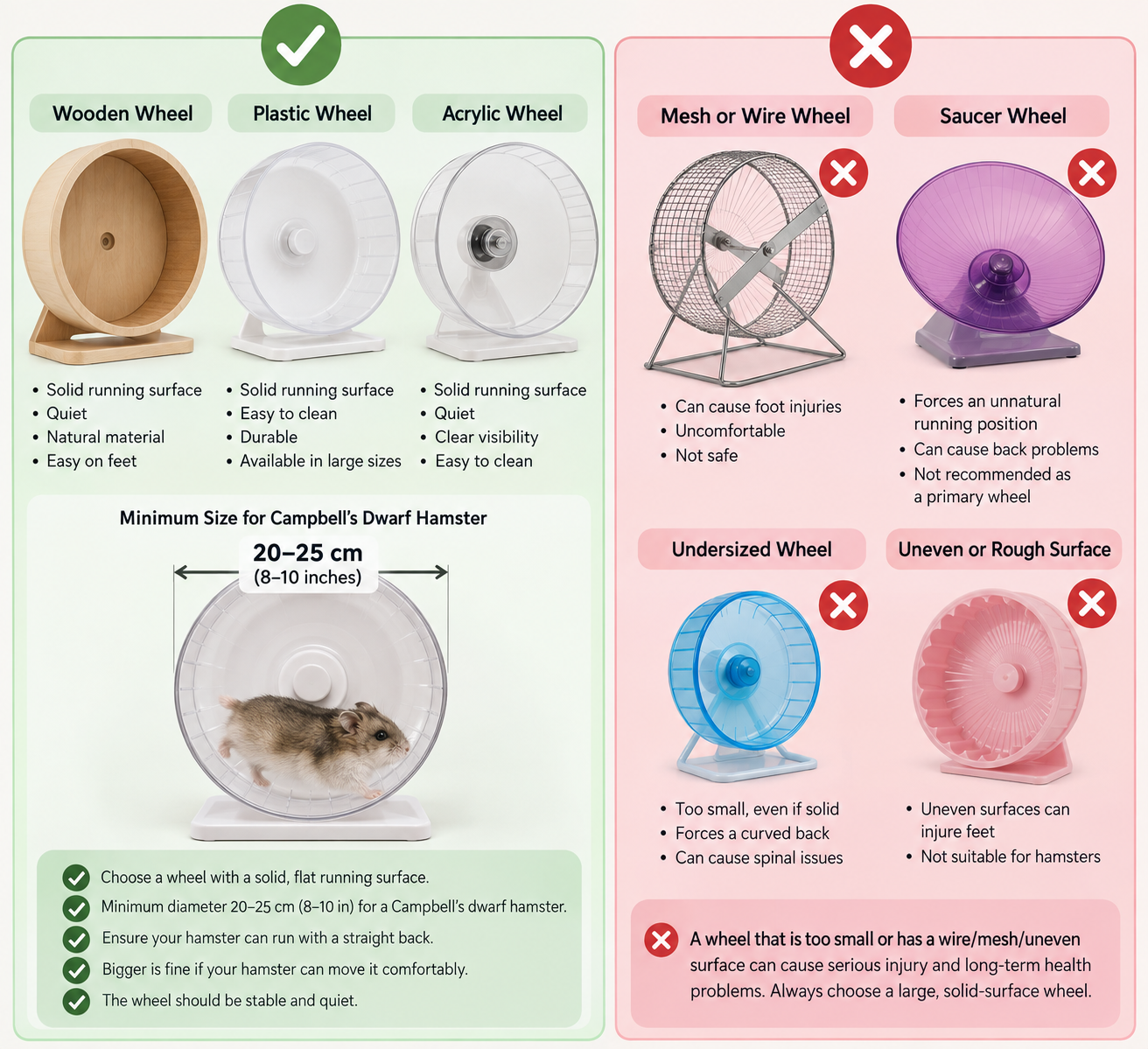
Provide a solid upright wheel at least 20–25 cm (8–10 in) in diameter for a Campbell’s dwarf hamster. Bigger is fine if the hamster can move it comfortably. Their back should remain straight while running. Avoid wire, mesh and saucer-style wheels as the primary wheel.
Water
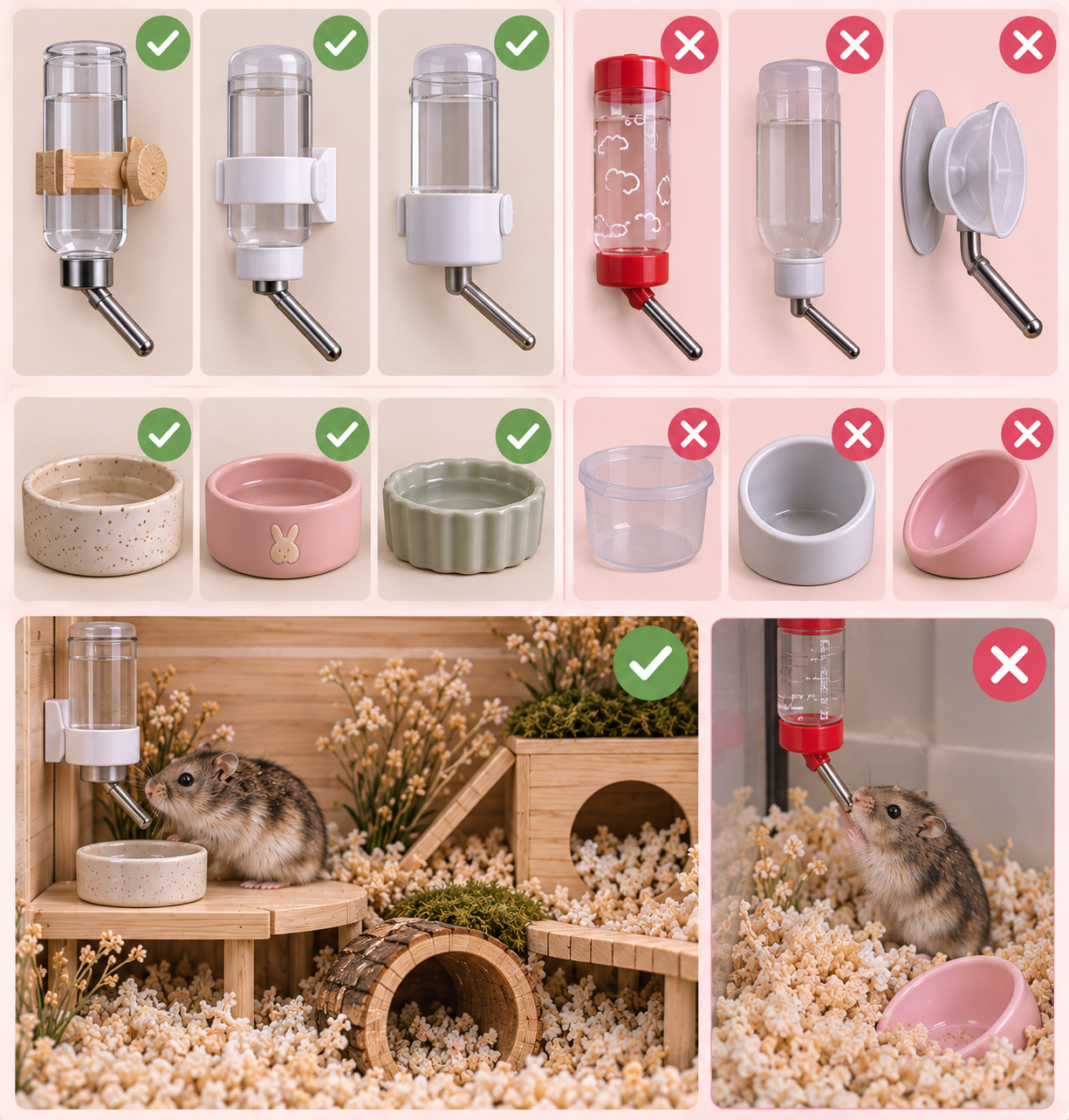
Fresh, clean water should be available at all times.
You can provide:
♡ a secure water bottle
♡ a shallow ceramic water bowl
♡ or both for additional choice
Check bottles daily to make sure they are flowing correctly. Water bowls should be heavy, shallow and placed on a platform to prevent tipping or becoming buried in bedding.
Refresh drinking water every day.
🍽️ Food Bowls
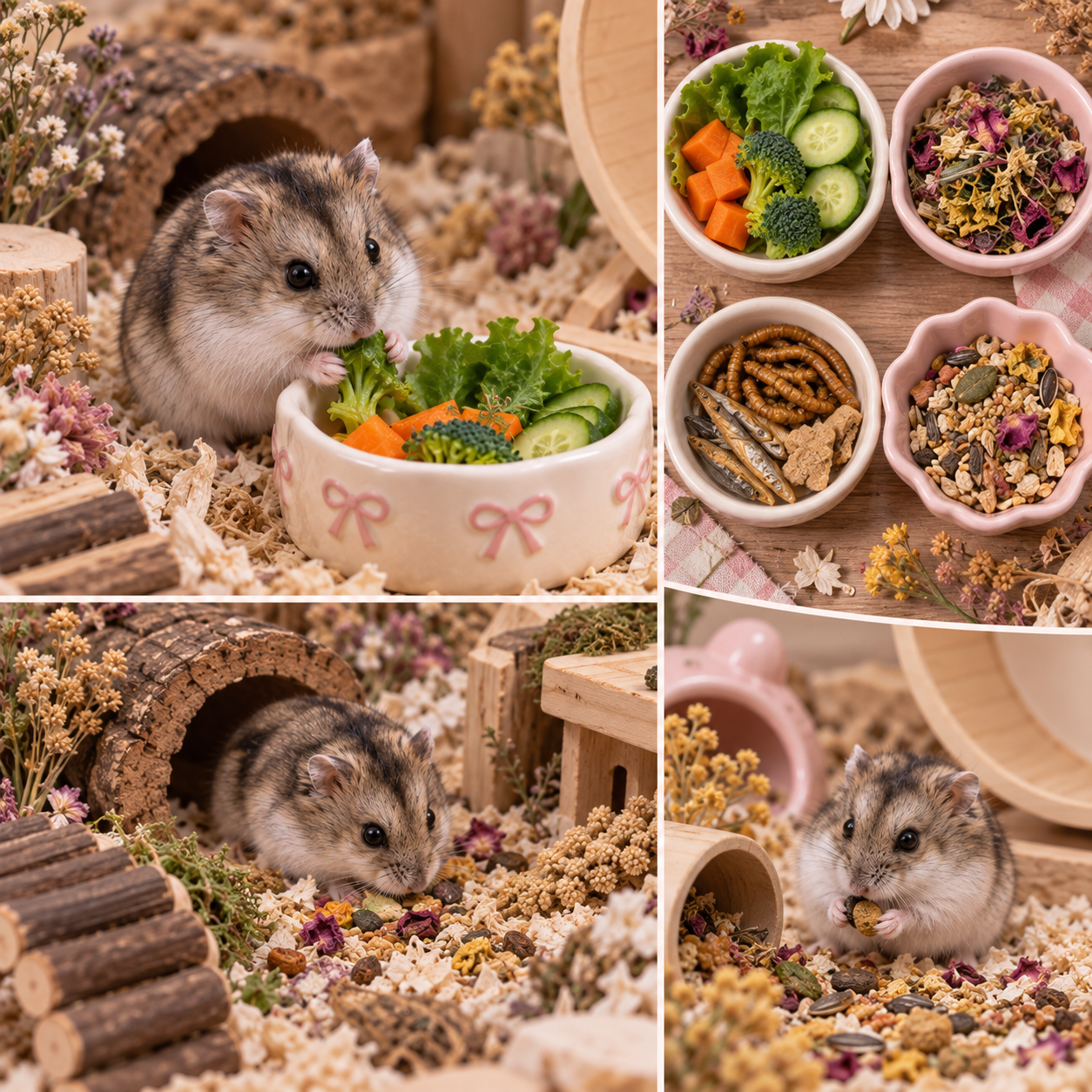
A small ceramic bowl can be useful for:
♡ fresh vegetables
♡ supplementary foods
♡ occasional protein foods
However, your hamster's dry diet does not need to be served entirely from a bowl.
♡ Little Moon recommends scatter feeding
Distributing dry food throughout the enclosure encourages your hamster to search, forage, pouch and store food naturally.
🌾 Nutrition
Campbell’s dwarf hamsters are omnivores and need a varied, balanced diet containing seeds, plant foods and an appropriate source of protein. Their staple should be a complete dwarf-hamster food, rather than a plain seed blend. Woodgreen recommends dwarf mixes containing plenty of smaller seeds alongside grains/pulses and protein such as dried mealworms.
🥄 How Much?
Offer approximately:
5–8 g of dry food per day ♡
This is a useful starting point for Campbell’s dwarf hamsters; adjust according to the food manufacturer's instructions and your hamster's weight, body condition and food stores.
♡ A Balanced Diet Can Include
♡ Small seeds — millet, flax and other suitable seeds
♡ Grains & pulses — as part of a complete mix
♡ Dried mealworms — a useful source of animal protein
♡ Seed sprays — millet, sorghum, flax and amaranth for foraging
♡ Fresh vegetables — tiny portions of broccoli, cucumber, courgette, green beans or suitable leafy greens
♡ Occasional protein — a little boiled egg or mealworm if appropriate for the existing diet
If the complete food already contains sufficient mealworms/protein, you do not need to add extra protein every day. Blue Cross and Woodgreen both include mealworms and small amounts of boiled egg among appropriate hamster foods.
🌿 Scatter Feed
Rather than placing the entire 5–8 g ration in a bowl, scatter it throughout the bedding and enrichment.
Searching for food encourages natural foraging, digging, pouching and hoarding behaviours. A small ceramic bowl can be reserved for fresh vegetables and occasional supplementary foods.
🍓 Keep Treats Tiny
Fresh and supplementary foods should be given in very small portions—roughly around the size of your hamster's ear is a useful guide. Avoid sugary, salty or highly processed treats, including honey-based seed sticks.
🌙 Little Moon Tip
Complete dwarf mix + small seeds + appropriate protein + tiny amounts of vegetables + natural foraging opportunities creates a much better foundation than filling a bowl with treats. ♡
Substrates
·
Sand Bath
.
Substrates · Sand Bath .
Hamsters are natural diggers and benefit from experiencing different textures beneath their feet and paws. Alongside their main deep bedding, providing additional digging substrates and a sand bath creates more opportunities for digging, grooming, exploring and natural scent-marking behaviours.
Provide at least three additional substrate areas, alongside the main bedding and sand bath, where enclosure space allows.
Suitable options may include:
♡ coco soil/coir
♡ cork granules
♡ safe, additive-free organic soil
♡ orchard grass hay
♡ sphagnum moss
Place these in separate shallow containers or digging areas so your hamster can choose between different textures.
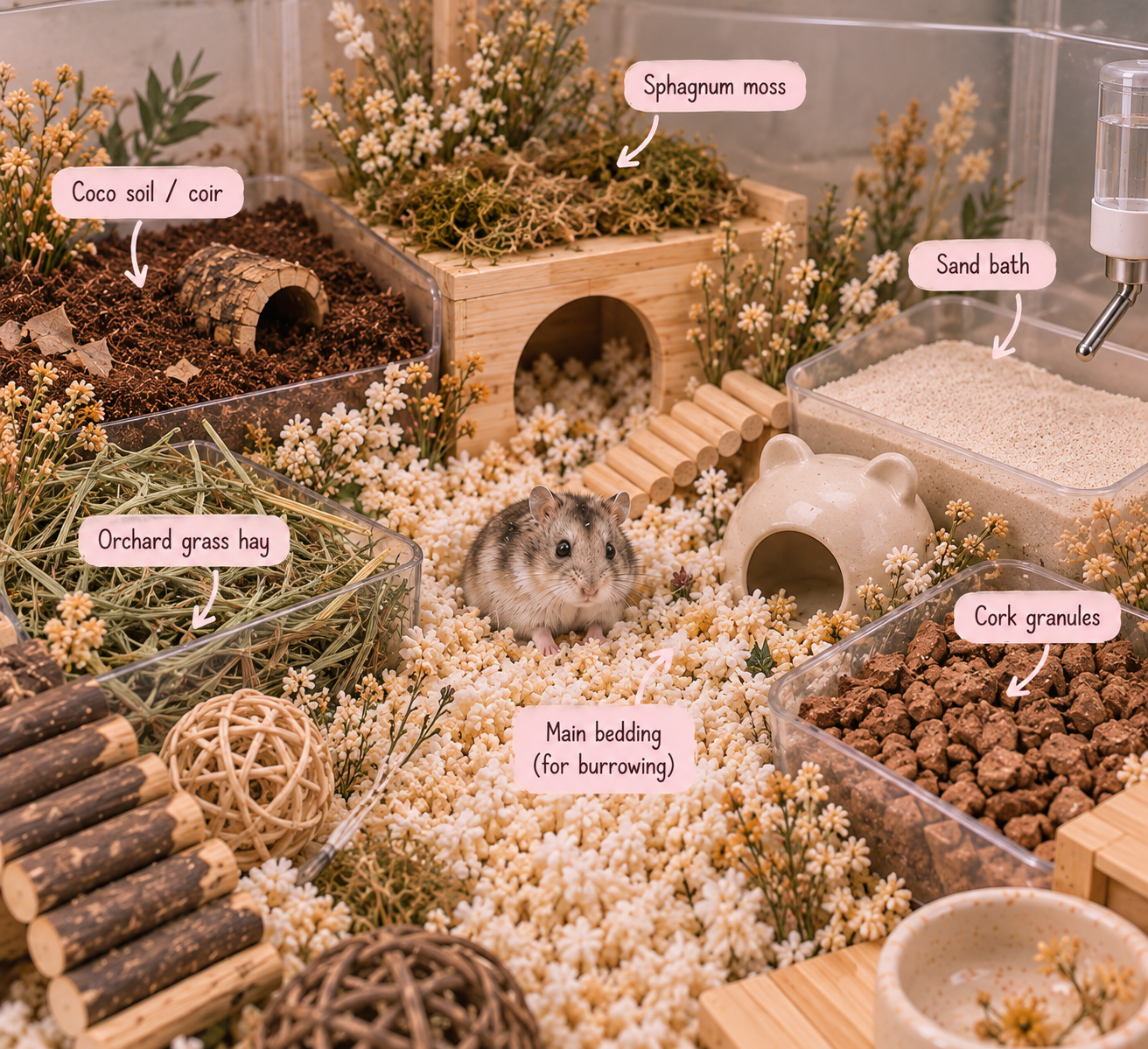
These are enrichment substrates and should not replace the 20–25+ cm of burrow-supporting main bedding.
✕ Avoid
✕ dusty substrates
✕ scented products
✕ fertilised soil
✕ soil containing pesticides or additives
✕ sharp or abrasive materials
✕ substrates that become excessively damp
🏖️ Sand Bath
✓ Essential environmental feature
A generously sized sand bath gives your hamster somewhere to dig, roll and maintain their coat naturally. Some hamsters will also choose to use their sand bath as a toilet.
The container should be large enough for your hamster to comfortably:
♡ enter and exit
♡ turn around
♡ dig
♡ roll and groom
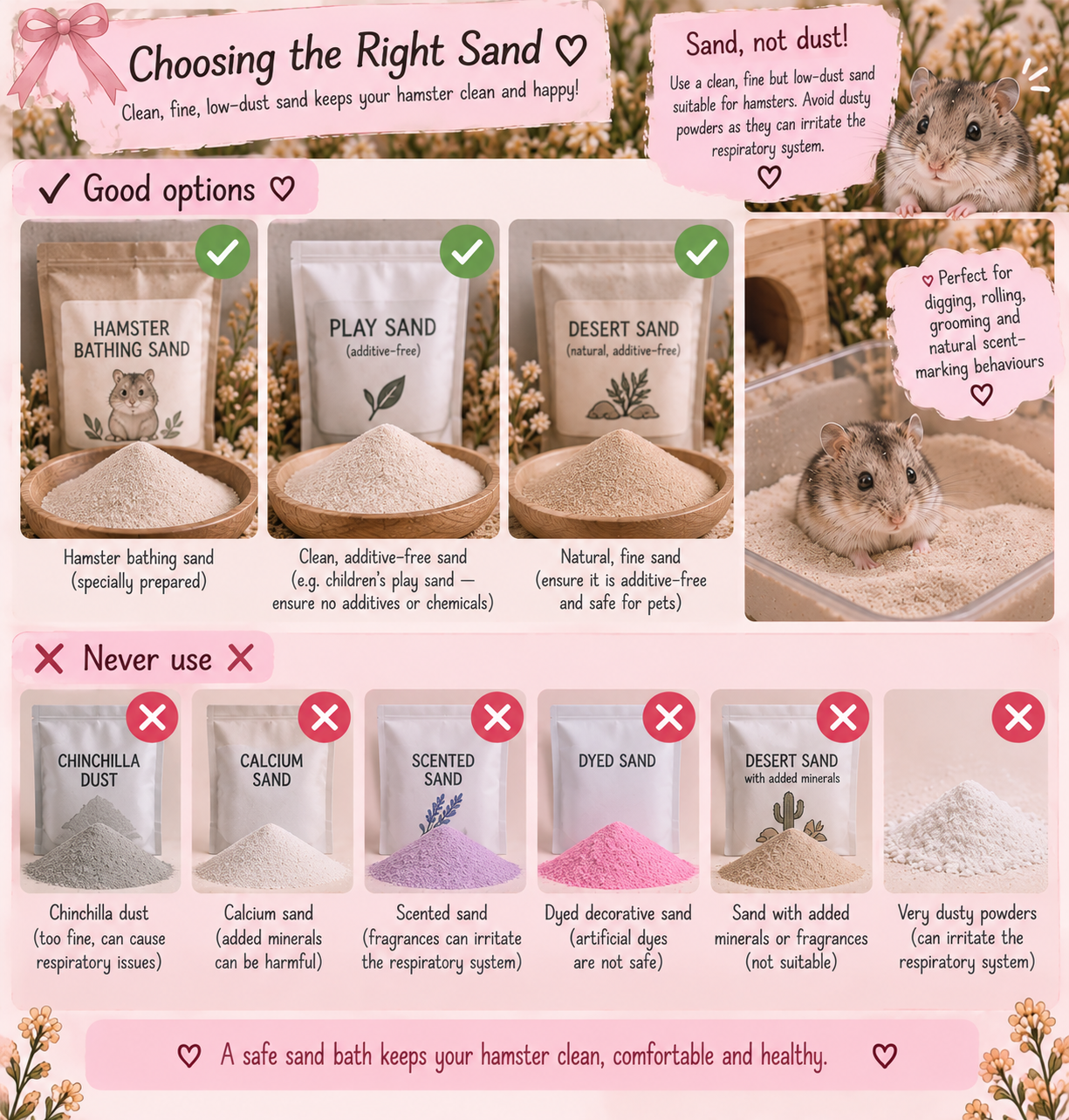
♡ Choosing Sand
Use a clean, fine but low-dust sand suitable for hamsters.
Appropriate options can include properly prepared hamster bathing sand or suitable additive-free sand that has been verified as safe.
✕ Never use
✕ chinchilla dust
✕ calcium sand
✕ scented sand
✕ dyed decorative sand
✕ very dusty powders
✕ sand containing added minerals or fragrances
The important distinction is sand, not dust. Very fine airborne particles can irritate the respiratory system.
🪵 Placement
Sand baths can become quite heavy, particularly when generously filled.
Place the sand bath on a secure platform or stable surface rather than directly on deep, loose bedding. This prevents it from sinking or becoming unstable if your hamster burrows underneath it.
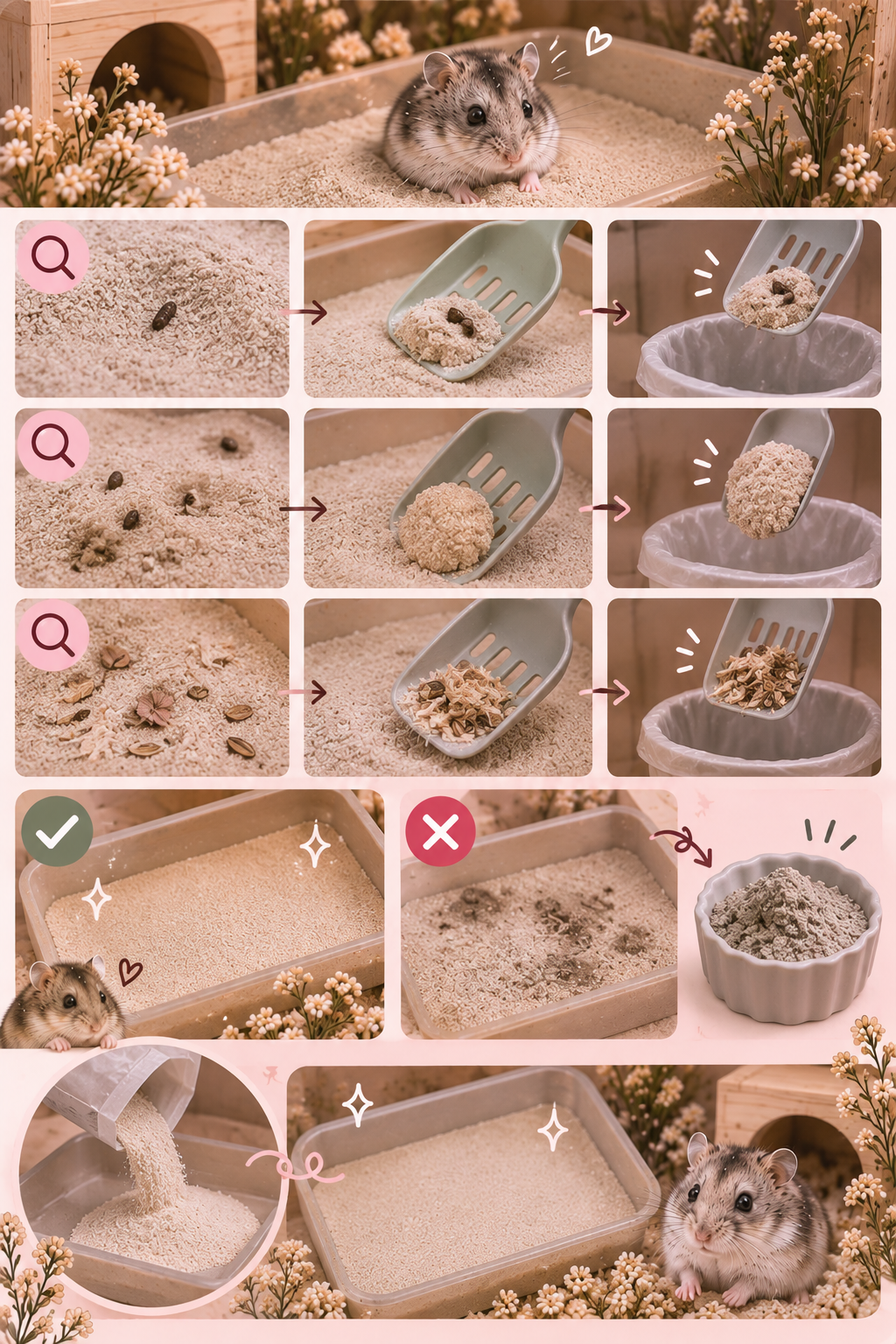
🧼 Keeping the Sand Clean
Check the sand regularly and remove:
♡ urine clumps
♡ droppings
♡ food
♡ bedding
♡ other contamination
If your hamster chooses the sand bath as a toilet, it may need more frequent spot cleaning.
Replace the sand when it becomes heavily soiled, damp or difficult to keep clean.
Health
·
Hygiene
.
Cleaning
.
Health · Hygiene . Cleaning .
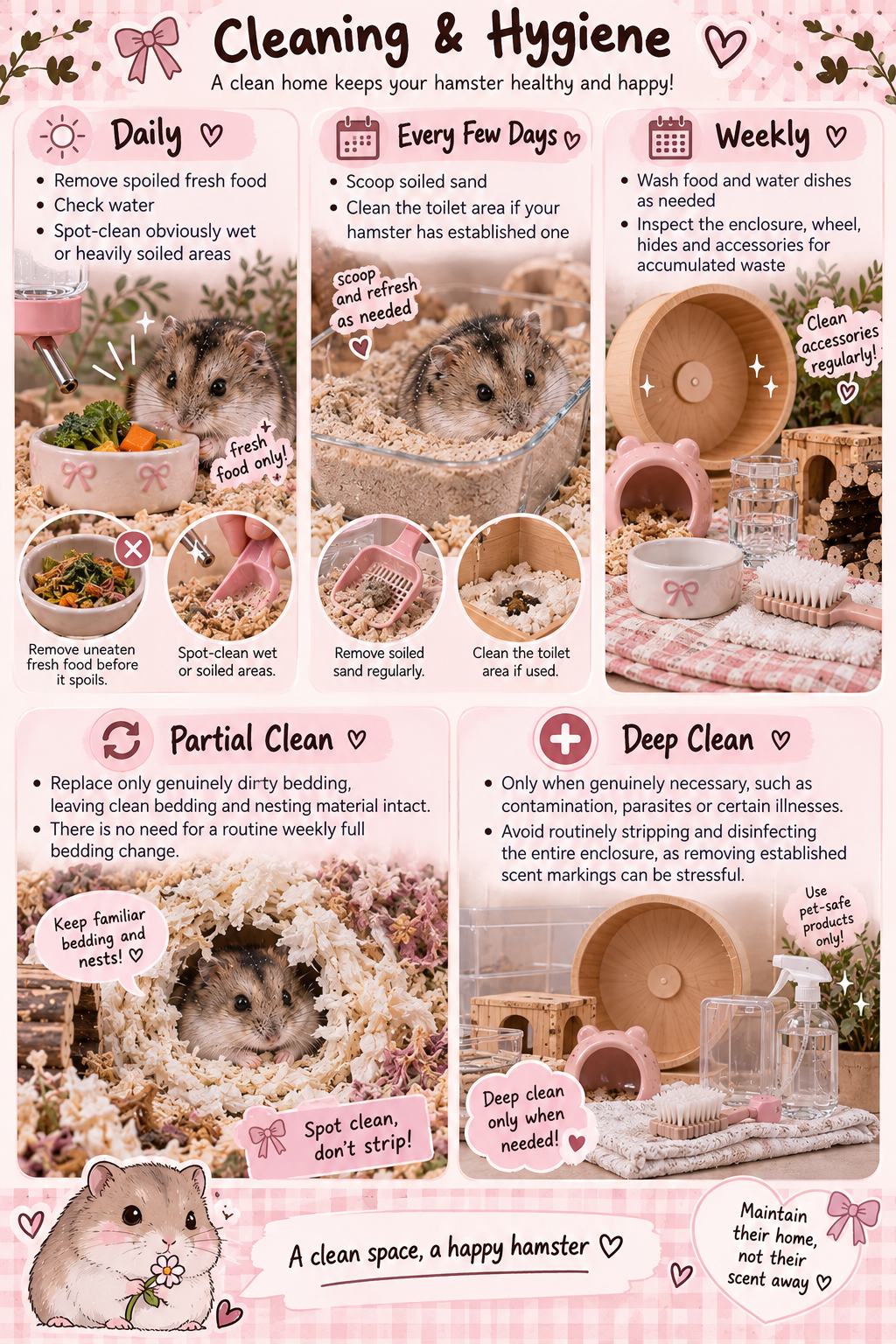
Hamsters have a highly developed sense of smell and use familiar scent markings to recognise their territory, navigate their enclosure and feel secure. Cleaning should therefore focus on removing waste and preventing harmful buildup — not removing every trace of your hamster's scent.
♡ Daily
Remove spoiled or uneaten fresh food, refresh/check drinking water, and spot-clean wet or heavily soiled bedding. Check your hamster's food stores and remove anything fresh that could spoil, but avoid unnecessarily disturbing dry food caches.
♡ Every Few Days
Scoop out visibly soiled sand and clean your hamster's toilet area if they have established one. There is usually no need to replace an entire sand bath simply because a small section has been used as a toilet.
♡ Weekly
Wash food and water dishes as needed and inspect the wheel, hides, tunnels, platforms and other accessories for urine, faeces or spoiled food. Clean individual items when they actually need it rather than cleaning everything at once.
♡ Partial Cleaning
Remove and replace only bedding that is genuinely wet, dirty or contaminated. Leave as much clean, familiar bedding as possible and preserve clean nesting material.
Avoid routinely replacing all of the bedding. Hamsters create an established scent landscape within their enclosure, and retaining familiar scents can help them recognise their home and feel secure.
♡ Why Familiar Scent Matters
Hamsters communicate and understand their environment largely through smell and scent marking. Their enclosure gradually becomes familiar through their own scent.
Removing all of those smells at once can make an otherwise familiar enclosure seem unfamiliar and may encourage increased scent marking or other signs of disturbance. A hamster enclosure does not need to smell completely neutral to us to be appropriately clean.
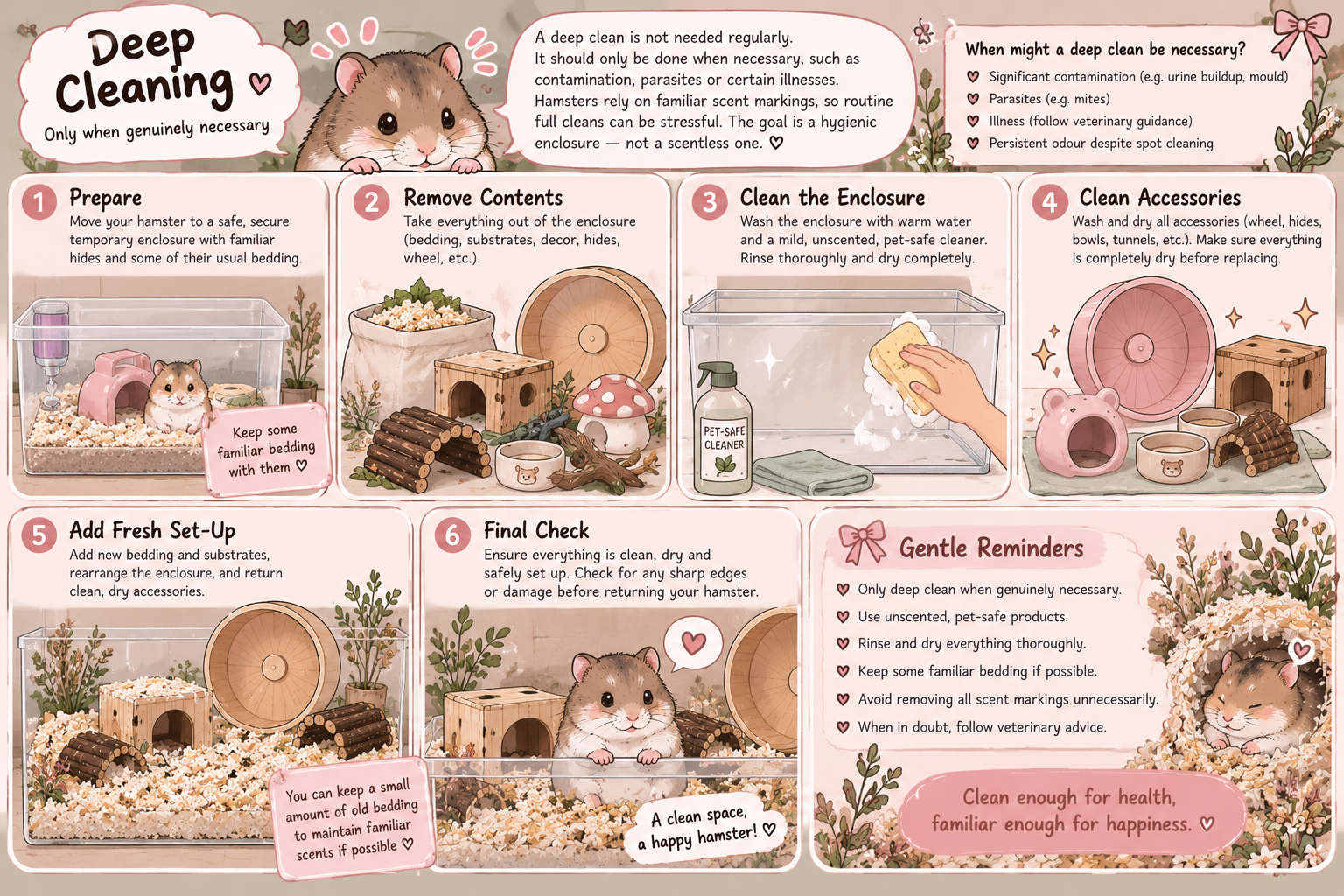
♡ Deep Cleaning
A complete clean should be reserved for situations where it is genuinely necessary, such as significant contamination, certain parasite problems or illness where veterinary guidance requires more thorough sanitation.
When a deeper clean is necessary, use hamster-safe cleaning methods, rinse and dry items thoroughly, and follow veterinary advice when cleaning because of infectious disease or parasites.
The goal is a hygienic enclosure — not a scentless one. ♡
🩺 Health & Wellness
Hamsters can hide signs of illness, so becoming familiar with your hamster’s normal appearance, weight and behaviour is an important part of responsible care. Because they are very small animals, health problems can sometimes progress quickly.
♡ Regular Health Checks
Keep an eye on your hamster’s:
♡ appetite & drinking
♡ body weight & condition
♡ activity & behaviour
♡ eyes, ears & nose
♡ coat & skin
♡ teeth & nails
♡ breathing
♡ walking & movement
♡ urine & droppings
⚖️ Monitor Their Weight
♡ Little Moon recommends
Weigh your hamster regularly using a digital kitchen scale and keep a simple record.
Small changes can be difficult to notice visually, so monitoring weight can help identify an unexpected downward or upward trend.
⚠️ Signs That Need Veterinary Attention
Contact an exotics veterinarian experienced with small mammals if you notice:
✕ loss of appetite
✕ unexplained weight loss
✕ excessive drinking or urination
✕ diarrhoea or a persistently wet rear
✕ difficulty breathing or unusual breathing sounds
✕ discharge from the eyes or nose
✕ wounds, swelling or lumps
✕ significant hair loss or persistent scratching
✕ difficulty walking or abnormal movement
✕ overgrown, broken or misaligned teeth
✕ hunched posture or marked lethargy
✕ sudden significant changes in behaviour
Blue Cross similarly advises owners to monitor hamsters for changes including reduced appetite, unusual drinking, weight changes, discharge, diarrhoea, breathing problems and lumps, and to seek veterinary advice when concerned.
🍓 Campbell’s Dwarfs & Diabetes
Campbell-type dwarf hamsters can be particularly susceptible to diabetes.
Possible warning signs include:
⚠ increased thirst
⚠ increased urination
⚠ unexplained weight changes
⚠ changes in appetite or activity
These symptoms can have several possible causes, so they should be assessed by a veterinarian rather than diagnosed or treated at home.
💊 Medication Safety
Never give your hamster:
✕ human medication
✕ leftover antibiotics
✕ medication prescribed for another pet
✕ cat or dog flea treatments
✕ unprescribed supplements or remedies
Medication for such a small animal requires careful veterinary selection and dosing.
🌙 Little Moon Standard
⚖️ Monitor: weight, appetite, drinking and behaviour
👀 Observe: your hamster regularly when naturally awake
🩺 Prepare: identify an exotics/small-mammal vet before an emergency
⚠️ Act early: don't wait for symptoms to become severe
💊 Medication: only under appropriate veterinary guidance ♡